Labels

Boer (3) Donkey (1) Garden (3) Garden Essentials (3) Goats (3) Kidding (3) Organic (1) Recycle (1) Tools (2)

Monday, May 30, 2011

Recycle-Reuse: Mason Jars

A fun, thrifty way to recycle is to save jars from goods in your pantry or refrigerator. Afterall, you've already paid for the jar and its contents. Reusing the jar for a handy purpose is better than tossing it into the trash or recycling bin. We've been collecting mason jars of various shapes and sizes for a couple of years, and we now have a cupboard full of cute drinking glasses.


mason jar drink
intimateweddings.com/blog

The jars you choose may serve different purposes. My favorite jars are from Smuckers' Simply Fruit jellies. The small jars are embossed with images of fruit, and they are the perfect size for juice glasses.

Simply Fruit

Other great jars to consider include jalapenos (wide-mouth), olives (tall, slender), and pasta sauce jars (tall, square).

Preparing the jar:
1. After using the product (which could take a few months), rinse the jar thoroughly.

2. Peel off the label. Some labels peel off very easily, but others you may have to scrape. For stubborn stickiness, use nail polish remover.

3. Run the jar through the dishwasher to remove any remaining residue.
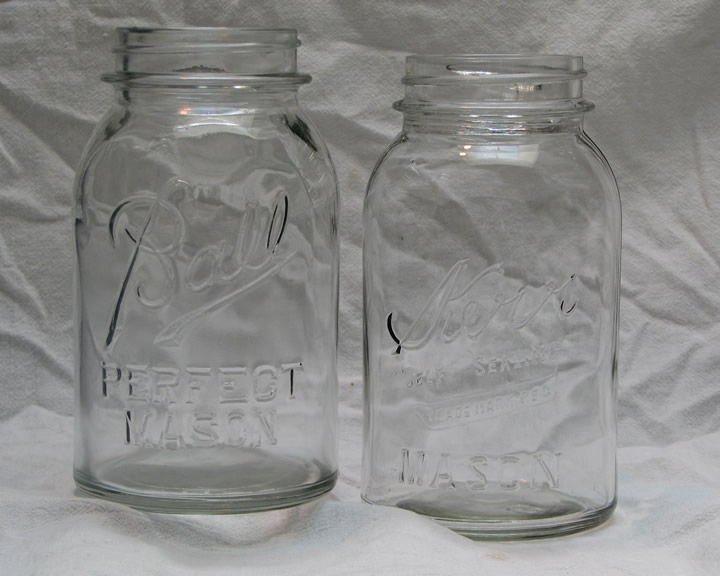

File:Antique Mason jars.jpg

Enjoy your new "free" and "friendly" drinking glasses!

Also look for "free" jars from local restaurants. For example, Joe's Crab Shack (www.joescrabshack.com) serves alcoholic beverages in Mason jars that you can keep. Pappadeaux Seafood Kitchen (www.pappadeaux.com) serves a delicious banana pudding in a Mason jar -- if you're lucky, you may get to keep the jar when you take the dessert to-go!

Saturday, May 7, 2011

Goodbye to Chance and Henry

We knew the day would come when we had to say goodbye to our first pair of kids, but the day came much faster than anticipated. Chance and Henry left our farm to join a herd in Leonard, Texas. The bucklings had started eating grass, although never ate grain, so I'm hopeful they were weaned or almost-weaned from the mother, Lucy.

Lucy, Henry, and Chance sharing their last moments together.

I felt very sneaky plucking the babies from the pasture while Lucy grazed down near the pond. In the last few weeks, she had gotten comfortable leaving them behind while she wandered with Lucky to drink from the pond or eat fresh weeds. We took advantage of the comfort she'd nurtured over the few weeks of life she shared with her babies.


Chance

Chance was attacked by Levi the donkey a couple of weeks earlier. Levi held him in his mouth and was running for the back pasture when I ran over and screamed at him to drop the buckling. Poor Chance was motionless, though standing. I held him in my lap for 20 minutes and he slept peacefully. He recovered completely from the traumatic experience.


Cuddling one last time

Unfortunately, Lucy did not fare well after the babies left. She cried for a few days and her bag of milk was so engorged that I tried to relieve her pain by milking her (unsuccessfully). We learned the hard way that one kid should be separated at a time, allowing a week of adjustment in between weanings. It broke my heart to hear her calling for her babies, as I can only imagine the pain she felt after losing both kids at one time.


Henry scraping his horns on my boots.
Henry was the bigger, more mature buck. He must have imprinted on my boots, because he loved to rub his forehead and horns up and down on the rubber material.


Chance and Henry saying goodbye to Kate.
We'll miss those guys! Our other goat, Lucky, recently had a boy and a girl. We're happy to have a girl kid, because she'll stay with us -- one less baby to wean!

Thursday, April 21, 2011

Garden Essentials: Gloves & Boots

A significant phobia of arachnids limited my enjoyment of gardening for many years, despite others' logical arguments that spiders are beneficial for the garden because they control unwanted pests. Recently, I've found a sense of security from the eight-legged creatures through certain "protective" equipment: my knee-high gardening boots and thick gardening gloves.

Tucker loves his garden boots!

In fact, I found myself encouraging my toddler to stop pestering the black jumping spider who lives in one of the Brussels sprout plants. I'm hoping the spider will eat the pest who devoured the leaves off of our beet seedlings!

Garden and work gloves

I have a pair of garden gloves, with thick traction that helps with tool use, such as the 3-pronged rake I use to lift weeds and till. I also keep a pair of thicker work gloves for barn work, such as lifting heavy bags of feed or moving hay. I figure the germs from the barn are much different than those in my organic garden, and I don't want to risk contaminating our food with the animals' bacteria.


Stock up on your supply of gloves and boots!

Check out these cute bug boots from Norcross.


Monday, April 18, 2011

Garden Essentials: Seeds of Change

This year, we ordered our seeds from the organic supplier Seeds of Change (http://www.seedsofchange.com). The company has a detailed, comprehensive website and catalog that provides beautiful colored photos of various fruits and vegetables (and their different varieties), as well as information about planting and harvesting.


The company provides many options for seed orders, from small packets (about 100 seeds each) to bulk sets of 5,000 or even 1,000,000 seeds for organic farms. The seeds are researched in test farms around the country before going to market, and they offer many heirloom varieties as well as newer hybrids -- but all organic!

I was especially impressed with the packaging material. Each set of seeds was neatly packaged in a yellow, zip-lock earth-friendly pack with detailed instructions about planting, harvesting, and enjoying the plants. There are even tips on how to harvest the seeds from the plants so you can reap even more benefits from your organic garden.

We ordered the following seeds for our garden this year:

Beans, Roma 2 (Bush)
Beets, Pronto
Carrots, Scarlet Nantes
Corn, Chires Baby (Sweet)
Cucumber, Mideast Prolific
Muskmelon, Blenheim Orange
Watermelon, Dakota Rose
Okra, Windy Wood Green
Pea, Sugar Snap
Pepper, Cal Wonder Orange Bell
Tomato, Peacevine (Cherry)
Alyssum, White Sweet
Echinacea, Purple Coneflower
Sage, Texas Hummingbird
Chives, Staro
Dill, Dukat
Parsley, Forest Green
Chamomile, German

Potato Tubers, Yellow Finn (2 lbs. of live tubers) -- supposed to be a delicious buttery variety.

Still in the progress of planting the garden, but hope to have a bountiful organic harvest in the coming months.

Friday, April 8, 2011

Meet Lucky the Goat

Our goat named Lucky has not been so lucky afterall. When we picked her up with the other goat (Lucy) and the donkey (Levi), she was in the back of the pasture with her head stuck in the fence, munching on some fresh grass on the other side. Grant pulled her free, and I loved her white markings. I named her Lucky because I felt lucky that we had "freed" her from the fence so she could come home with us.

Lucky the Boer Goat

Little did I know that Lucky's favorite pasttime would be getting her head stuck in the fence. The first time I had to free her from the fence was bright and early on a school day, when Tucker and I were driving down the long rocky driveway on our way to school. I noticed she was stuck, so I hiked through the grass and dirt in my black heels and black dress pants, knelt down to grab her horns, and proceeded to wrestle with her for about 10 minutes before she gave in enough to allow me to push her long horns through the square opening of the fence. She wiggled free, ran a few feet away, and then turned to look at me, as if saying, "Thanks!" What a great way to start the day! I felt like a real country girl from that point on :)

Since those first wrestling matches with Lucky, we've resorted to letting her figure out how to get out of her sticky situation herself. So far, she always manages to free herself, so I'm not too worried. Of course, if we hear bleating for more than a few minutes, we run out to check on her (and to make sure the donkey isn't chasing the goats again). Lucky has a permanent bald spot at the back of her neck from scraping the hair on the fence wires.

We are excited to welcome a new baby soon, though! Lucky was the only goat out of the herd of 5 does that didn't appear to be impregnated by the 1 buck at the home of the guy who gave them to us. I chose Lucy because she was clearly pregnant, and I chose Lucky as an adult companion -- not quite sure if she was with-kid. She is clearly expecting now, and hopefully the new kid(s) will make his/her appearance any day now. She's looking swollen in her nether-regions, and her milk bag is filling out. Just as we are losing Chance and Henry, our first two baby goats, we will be welcoming a new addition.

Monday, March 28, 2011

Garden Essentials: Bucket and Caddy

Having the right tools is essential for maintaining an efficient, productive garden. We received this wonderful bucket caddy and many handy tools for a wedding gift from my cousin. The caddy simply wraps around a 5-gallon bucket and includes pockets for just about every garden tool, cell phone or cordless phone, and pens/pencils. There is also a flap that velcros open to reveal 8 or 10 pockets for seed packets. Such a convenient way to carry along all of your tools, without the risk of leaving them in the garden!


While you could carry seedlings or collect weeds in the bucket, I prefer to keep my gloves and notepad (with a sketch of the garden plans) in the bucket. I make sure to bring the bucket inside the house when I'm finished in the garden, which prevents bugs from invading my gloves and tools, and keeps the tools safe from the rain. Convenience is the key to successful gardening!

Meet Levi the Donkey

Meet our donkey named Levi. He's sweet and friendly, if you approach him gently and offer treats. He loves to munch on peppermint horse treats.

Levi
Tucker saying "Hi" to Levi
Looking for treats
Levi brays (or hee-haws) when he wants attention, day and night. We've tried to introduce him to the baby goats, but he chased them around the pasture and tried to bite at their legs. Levi stays on our back pasture and keeps away the coyotes and other critters.

I'd like to get a companion for Levi, besides the goats and our neighbor's cows. But not sure we want to take up donkey breeding as a side business. Levi is much more aggressive than our goats, and his size can be intimidating. The adage "never walk behind a horse" holds true for Levi -- now if only it were easy to teach a two-year-old to heed the warning.

As a first-time donkey owner, I've been learning a lot about caring for him from The Donkey Companion, by Sue Weaver. The book covers the essentials, along with some interesting facts about donkeys in history.

Sunday, March 20, 2011

Welcome to our two bucklings!

One of our Boer does, Lucy, gave birth to two adorable bucklings on 2/13/11. Henry is the larger, red kid, and Chance has black markings (black legs, stomach, and a black line down his back). Our first kidding was successful!


The book, Raising Goats for Dummies,was very helpful in preparing for the birth. We were prepared with old towels to rub down the newborns, iodine to dip the cords, and dental floss to tie off the cords.


We need to find a loving home for our two bucks, since we aren't prepared to care for the soon-to-be-weaned, energetic bundles of hormones! But we don't want them to be sold for meat, which will be tricky to avoid. Any interested buyers in the North Dallas area, please contact us!